


A moving company rating is a numerical score compiled from multiple review platforms, reflecting customer feedback on punctuality, professionalism, pricing transparency, handling care, and overall satisfaction. Think of it as a compressed reputation report. Platforms like Google Reviews, the Better Business Bureau (BBB), and the Canadian Association of Movers each contribute data points that, taken together, give you a snapshot of how a mover actually performs. The industry term for this aggregated measure is a moving service rating, and understanding what goes into it is the single most useful thing you can do before signing any moving contract.
What is a moving company rating and how is it calculated?
A moving service rating is not one number from one source. It is an aggregated score drawn from several platforms, each measuring slightly different things. Google Reviews captures raw customer sentiment through star scores and written comments. The BBB assigns letter grades based primarily on complaint history and resolution. Industry bodies like the Canadian Association of Movers track licensing compliance and professional standards.
The criteria customers most commonly rate include:
- Punctuality: Did the crew arrive and deliver within the agreed window?
- Care with belongings: Were items packed, loaded, and unloaded without damage?
- Pricing transparency: Did the final invoice match the written estimate?
- Professionalism: Were crew members courteous, communicative, and prepared?
- Complaint handling: When something went wrong, did the company respond promptly and fairly?
Star ratings compress all of this into a single number, which is convenient but reductive. A 4.7 on Google tells you customers were generally happy. It does not tell you whether that happiness came from a hundred local moves or three long-distance ones. Written reviews fill that gap, providing the narrative context that a star score cannot. The difference between a rating and a review matters: ratings summarise, reviews explain.
BBB letter grades work differently from star averages. The BBB weighs complaint volume, how quickly complaints were addressed, and whether resolutions were satisfactory. A company with several complaints but a strong resolution record can still hold an A rating. That is a meaningful distinction, and one most consumers overlook.

How should you interpret moving company ratings?
Knowing how to read a rating is as important as knowing where to find one. Review volume and recency are your first filters. A company with 10 reviews and a 5.0 average is far less informative than one with 300 reviews and a 4.4 average. Aim for companies with at least 10 recent reviews, and weight the last six months more heavily than older feedback.
Watch for these red flags when reading moving company reviews:
- A lopsided distribution of five-star and one-star reviews with almost nothing in between
- Reviews that use identical phrasing or post within days of each other
- Glowing reviews that mention no specific details about the move
- A sudden spike in positive reviews following a period of negative ones
Fake or incentivised reviews can inflate average ratings significantly. A 4.2 average might mask a cluster of serious one-star complaints about lost items or surprise fees. Reading those lower-rated reviews is not pessimistic. It is practical.
Counter-intuitively, mid-level reviews (three and four stars) often reveal the most useful operational information. Customers who give three stars are rarely venting or gushing. They are describing what actually happened: the crew was great but the quote was off by 20 percent, or delivery was a day late but the company communicated throughout. Repeated mentions of delays, unexpected fees, or quoting discrepancies in that range are a stronger signal than a handful of one-star rants.
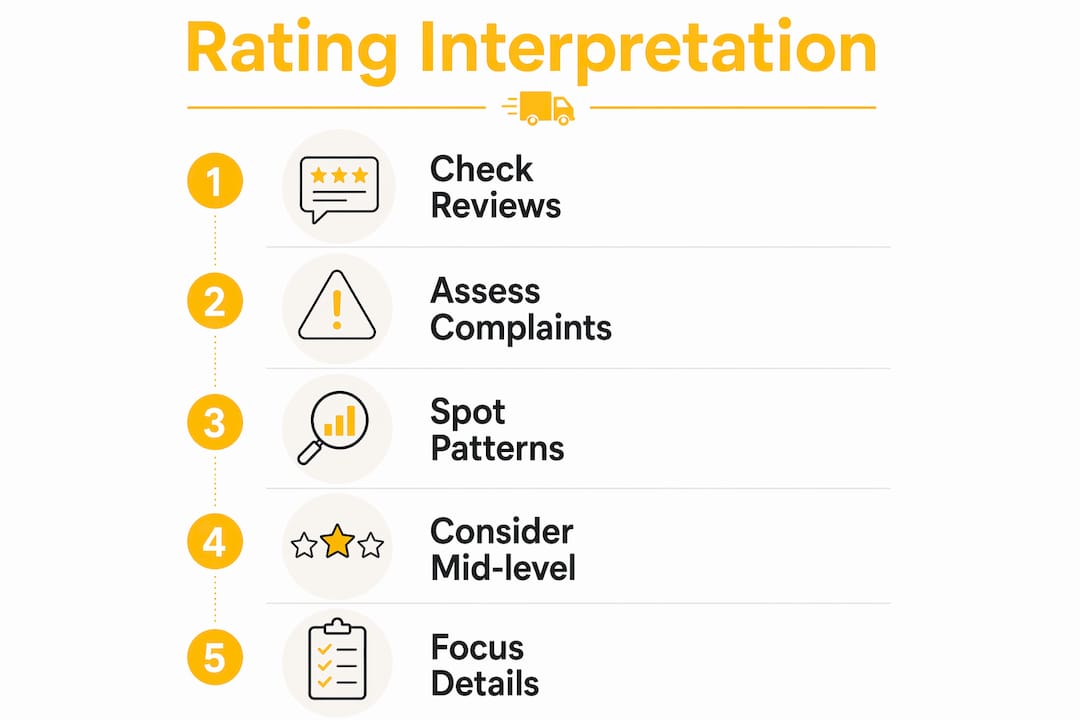
A lower overall star rating may suit your needs better than a perfect score if the company specialises in exactly the type of move you are making. A 4.2-rated mover with 200 reviews specifically mentioning careful piano handling is a stronger choice for a piano move than a 4.9-rated generalist with no mention of specialty items.
Pro Tip: Focus on detailed reviews that mention named crew members, specific delivery outcomes, or itemised billing. These are the reviews written by people who actually moved, not by marketing departments.
How do BBB complaints affect moving company ratings?
The BBB complaint system is one of the most misunderstood tools in consumer research. Many people assume that any complaint is a red flag. The BBB operates differently. BBB complaint handling emphasises responsiveness and mediation. A company that receives complaints and resolves them promptly can maintain a strong letter grade. A company that ignores complaints, even minor ones, will see its grade fall.
Here is what the BBB complaint process actually involves:
- A consumer files a complaint through the BBB portal
- The BBB forwards it to the company, which typically has 30 days to respond
- Resolved complaints are marked as closed but remain visible for three years
- Unresolved or unanswered complaints weigh heavily against the letter grade
The BBB also distinguishes between accredited and non-accredited businesses. Accreditation requires a company to meet BBB standards for trust and pay an annual fee. Non-accredited companies can still be rated, but they have not committed to the BBB’s code of conduct. This distinction matters when you are comparing two companies with similar letter grades.
BBB complaint resolutions are a better gauge of trustworthiness than raw complaint counts. A mover with 15 resolved complaints is more trustworthy than one with 2 unresolved ones. Read the complaint details and the company’s written responses. How a company communicates under pressure tells you more about its character than any star average.
Pro Tip: Use the BBB profile alongside Google Reviews and any industry association listings. No single platform gives you the full picture. Three platforms together come close.
How to combine ratings with due diligence when choosing a mover
Ratings are one piece of the decision. Cross-checking multiple platforms for the same company helps reconcile differences that can result from regional crew variability or subcontractor use. A company that scores 4.8 in Toronto but 3.6 in Ottawa may be using different crews in each city. That inconsistency is worth investigating before you book.
Follow these steps to build a complete picture of any moving company:
- Check ratings on at least three platforms: Google, BBB, and one industry-specific source.
- Verify licensing: In Canada, long-distance movers must hold a valid carrier licence. Ask for it directly.
- Request written estimates from at least two companies: Compare line items, not just totals.
- Read the complaint details on BBB: Look at how the company responded, not just whether complaints exist.
- Contact the company directly: Ask about crew consistency, subcontractor use, and what happens if something is damaged.
Use a comparison framework like this when evaluating your shortlist:
| Factor | What to look for |
|---|---|
| Star rating (Google) | 4.0 or above with 50+ reviews |
| BBB letter grade | A or B, with resolved complaints |
| Licensing status | Valid carrier licence confirmed |
| Written estimate | Itemised, binding or not-to-exceed |
| Complaint response | Prompt, professional, solution-focused |
Ratings combined with licensing and complaint history give you a far more reliable picture than any single score. A company that scores well across all five factors is genuinely low-risk. One that scores well on stars but poorly on licensing or complaint response is not.
Consistent satisfaction across multiple platforms is the strongest trust signal available. It means the company performs reliably regardless of which crew shows up or which city you are moving to. For long-distance moves especially, that consistency matters more than a perfect score on one platform.
Key takeaways
A moving company rating is only reliable when read across multiple platforms, combined with complaint history and licensing verification.
| Point | Details |
|---|---|
| Ratings are aggregated scores | Google, BBB, and industry platforms each measure different aspects of service quality. |
| Mid-level reviews reveal the most | Three and four-star reviews expose operational patterns that extreme ratings hide. |
| BBB grades reflect complaint handling | Responsiveness and resolution matter more than the absence of complaints. |
| Cross-platform consistency is key | Agreement across Google, BBB, and industry sites signals genuinely reliable service. |
| Ratings alone are not enough | Combine star scores with licensing checks, written estimates, and direct contact. |
What we have learned from years of moving reviews
After years of working in the moving industry and reading thousands of customer reviews across Canada, one pattern stands out clearly: most people read ratings backwards. They start with the star average and stop there. The star average is the least useful number on the page.
What actually predicts your experience is the company’s behaviour when things go wrong. Every mover has a bad day. The question is whether they own it. When we read our own reviews at Bravosmoving, the feedback that tells us the most is not the five-star praise. It is the three-star review where a customer says the crew was great but the quote was unclear. That is the review that drives real improvement.
We have also noticed that marketing can distort ratings in ways that are hard to detect. A company that actively solicits reviews after every successful move will naturally accumulate a higher average than one that does not. That does not mean the second company performs worse. It means the first company has a better review acquisition strategy. When you see a company with a suspiciously high volume of five-star reviews posted in short bursts, treat that as a data quality problem, not a quality signal.
Our honest advice: prioritise companies that respond to negative reviews publicly, in writing, with specific solutions. That behaviour is harder to fake than a star average, and it tells you exactly how the company will treat you if your move does not go perfectly.
— Bravos
Move with confidence backed by real ratings
Choosing a mover is easier when you know what to look for and where to look. Bravosmoving holds a 4.5-star rating from over 4,500 customers across residential, commercial, and long-distance moves. Every estimate is written, itemised, and transparent. Every crew member is trained and licensed.

Whether you are relocating locally in Toronto, planning a long-distance move, or need professional packing services to protect your belongings, Bravosmoving offers the full range of support you need. Explore the complete list of professional moving services and see why thousands of Canadians trust Bravos for their most important moves.
FAQ
What is a moving company rating based on?
A moving company rating is a numerical score compiled from platforms like Google, the BBB, and industry associations, reflecting customer feedback on punctuality, pricing, professionalism, and complaint handling. It aggregates multiple data points into a single reference score.
How many reviews should a moving company have before I trust its rating?
Prioritise companies with at least 10 reviews, and weight recent feedback more heavily than older entries. A company with 100 reviews and a 4.3 average is more reliable than one with 5 reviews and a 5.0 average.
Are BBB complaints a dealbreaker when evaluating movers?
Not automatically. BBB complaint resolutions matter more than complaint counts. A company that resolves complaints promptly and professionally demonstrates accountability, which is a stronger trust signal than a company with zero complaints and no review history.
Can moving company reviews be fake?
Yes. Fake or incentivised reviews can inflate average ratings. Watch for identical phrasing across reviews, sudden spikes in five-star scores, and a lack of specific detail about the actual move.
Should I choose the highest-rated moving company?
Not necessarily. A lower-rated mover with specialised experience in your move type may serve you better than a higher-rated generalist. Combine star scores with licensing verification, written estimates, and complaint history for the most informed decision.
Recommended
Comments ( 2 )
Leave a Reply
You must be logged in to post a comment.
[…] Consider the reviewer’s move type. Someone moving a studio apartment in downtown North York has different needs than someone relocating a four-bedroom house with a grand piano. A review praising careful handling of delicate antiques is valuable if that’s your situation; a review about quick, efficient apartment moves may not directly apply. Understanding moving company ratings helps you decode what each review really tells you. […]
[…] deeper guidance on evaluating moving companies, learning what moving company ratings actually mean helps you make decisions based on real indicators of quality, not just advertised […]